
Master of Climate and Disaster Resilience
Program Description
The Master of Climate and Disaster Resilience (MCDR) with an exit program in Graduate Certificate in Climate and Disaster Resilience (GCCDR) was instituted to address an urgent need to produce professionals who can strengthen the coherence and synergy between climate change adaptation (CCA) and disaster risk reduction (DRR) as climate change intensifies the frequency, scale, and complexity of disasters. Offered by the UP Open University in collaboration with UP Resilience Institute, the program is designed to cater to a wide range of professionals, including practitioners, administrators, planners, and educators, as well as those working in non-governmental organizations (NGOs), civil society organizations (CSOs), and others involved in DRRM and CCAM.
The MCDR program includes two course tracks: the Strategic Practice Track and the Community Resilience and Empowerment Track; both tracks are included in the program, taken after the second semester of coursework.
For students unable to complete the full master’s program due to unforeseen circumstances, they will have the option to earn the Graduate Certificate in Climate and Disaster Resilience (GCCDR) degree if they exit the program after completing 15 units of coursework, consisting of three (3) core courses and two (2) elective courses. The Master’s degree will be awarded to a student who completes 34 units of specified coursework with a general weighted average of 2.0 or better.
Program Goals
The MCDR program aims to develop graduates who are able to:
- Assess key concepts and principles of integrated and interdisciplinary approaches in climate and disaster resilience to develop comprehensive, evidence-based strategies for risk reduction and adaptation;
- Evaluate the interrelationships among the different factors that shape disaster risk and climate resilience using systems thinking;
- Apply transformative leadership, effective communication, and collaborative problem-solving skills to drive the development and implementation of equitable and context-specific climate and disaster resilience strategies;
- Design resilience strategies based on evaluations of climate-related and disaster risks from a holistic perspective, integrating a broad range of multi-, inter-, and transdisciplinary frameworks and considerations; and
- Develop evidence-based, cross-cutting solutions and programs that contribute to building climate and disaster resilience across diverse contexts.
Admissions
Applications for admission to the program will be evaluated by a Program Admission Committee (PAC) consisting of faculty members from the Faculty of Management and Development Studies (FMDS) and representatives from UP Resilience Institute (UPRI).
Any applicant must have:
- a bachelor’s degree from a recognized institution of higher learning.
- been recommended by two (2) previous professors or immediate supervisors.
- Submitted a statement of purpose (1000 words maximum) outlining their academic background, career goals, and motivations for pursuing a graduate degree in resilience.
- Submitted a concept proposal (500 words maximum) outlining their vision for their field project in Climate and Disaster Resilience.
Enrollment Procedure
Online Registration is done through the Student Portal. Follow these instructions on how to register online. If you have further questions, take a look at the Enrollment FAQs.
Mode of Instruction
Courses are delivered on a semestral basis with courses during the mid year term using the virtual classrooms run in MyPortal, the learning management system of the UPOU. This is where class announcements are made, course materials uploaded, discussions held and assignments uploaded.
Courses
The program offers two (2) separate tracks that are designed to enhance students’ skills on critically analyzing and utilizing research outputs that could help them tailor their learning to their career goals as well as enhance their skills and knowledge as practitioners and community capacity builders. These tracks are as follows:
- Strategic Practice Track, which will equip learners with advanced competencies needed to enhance their roles as practitioners in climate and disaster resilience. It is designed for individuals working as responders, policymakers, analysts, planners, and managers who are responsible for strategic decision-making and implementation. Participants in this track will develop the skills to lead and manage resilience efforts, carry out innovative strategies, and influence policy directions in relevant contexts. The track emphasizes the integration of science-based approaches and best practices in the field.
- Community Resilience and Empowerment Track, which will equip learners with competencies necessary in empowering local communities to become more resilient to climate and disaster risks. Recognizing that communities, including barangays, people’s organizations, and business sectors, are on the forefront of disaster and climate change impacts, this track focuses on capacitating educators, trainers, and other individuals involved in community-based resilience efforts. These individuals will gain expertise in community engagement, participatory planning, and grassroots capacity-building initiatives. The track emphasizes the vital role of local communities in DRRM and CCAM, fostering a culture of resilience and self-reliance at the grassroots level.
Microcredentials
Retention, cross-registration, transfer/shifting, and crediting of microcredentials, if there are any, must follow the existing rules and regulations of the University of the Philippines Open University and UP System. Courses taken from UP constituent universities and other universities can be considered for transfer of credit following the existing policies of crediting courses.
Program Structure
Total Number of Units: 34 units
1. Core Courses [12 units]
- CDR 201 Fundamentals of Resilience
- CDR 202 Systems Thinking and Complexity Science for Climate and Disaster Resilience
- CDR 203 Resilience and Risk Communication
- CDR 291 Special Topics in Climate and Disaster Resilience
2. Major Courses [9 units]
- Strategic Practice Track
- CDR 211 Contingency Planning and Response to Climate Change and Disasters
- CDR 212 Approaches to Climate and Disaster Resilience Planning and Decision-Making
- CDR 213 Disaster and Climate Risk Management in the Public Sector
- Community Resilience and Empowerment Track
- SW 231 Strategies in Community Mobilization
- CDR 221 Community-Based Practice for Climate and Disaster Resilience
- CDR 222 Approaches to Disaster Risk Reduction and Management (DRRM) and Climate Change Adaptation and Mitigation (CCAM) Education
3. Graduate Seminar [1 unit]
a. CDR 299 Graduate Seminar
4. Field Study [3 units]
a. CDR 298 Field Study in Climate and Disaster Resilience
5. Elective Courses [9 units]
- Cultural and Social Perspectives on Resilience
- CDR 270 Ang dalumat ng disaster sa pananaw at kamalayang Pilipino
- CDR 271 Historical Perspectives on Hazards and Disasters in the Philippines
- CDR 272 Gender and Disaster Risk Reduction
- CDR 273 Indigenous and Local Knowledge in DRRM and CCAM
- CDR 275 Disability-Inclusive Strategies for Climate and Disaster Resilience
- Community and Social Development Practice
- CDR 230 Field Practice in Community-based Disaster Risk Reduction and Management (CBDRRM) for Humanitarian-Development Peace Nexus
- CDR 231 Community-based Vulnerability and Capacity Assessment
- CDR 232 Institutional Actions for Disaster Response
- CDR 274 Understanding Disaster Resilience: A Psychological Perspective
- Technical Approaches in Risk Management
- CDR 250 Hazards and Exposure Assessment
- CDR 251 Operational and Applied Meteorology for DRRM Practitioners
- CDR 252 Water, Sanitation and Hygiene for Resilience
- Policy, Governance and Strategic Planning
- CDR 240 DRR and CCAM Policy Analysis and Advocacy
- CDR 241 Disaster Risk and Climate Financing
- CDR 242 Issues in Disaster Governance and Leadership
- Environmental Sustainability and Ecosystem Management
- CDR 260 Geodiversity and Geoheritage Towards Sustainability and Resilience
- CDR 261 Ecosystems-based Approaches to Climate and Disaster Resilience
- Education and Learning Strategies for Resilience
- CDR 280 Social and Emotional Learning in Climate and Disaster Resilience
- CDR 281 Instructional Design for Climate and Disaster-Resilient Instruction
- CDR 282 Inclusive and Equitable Education
Course Map
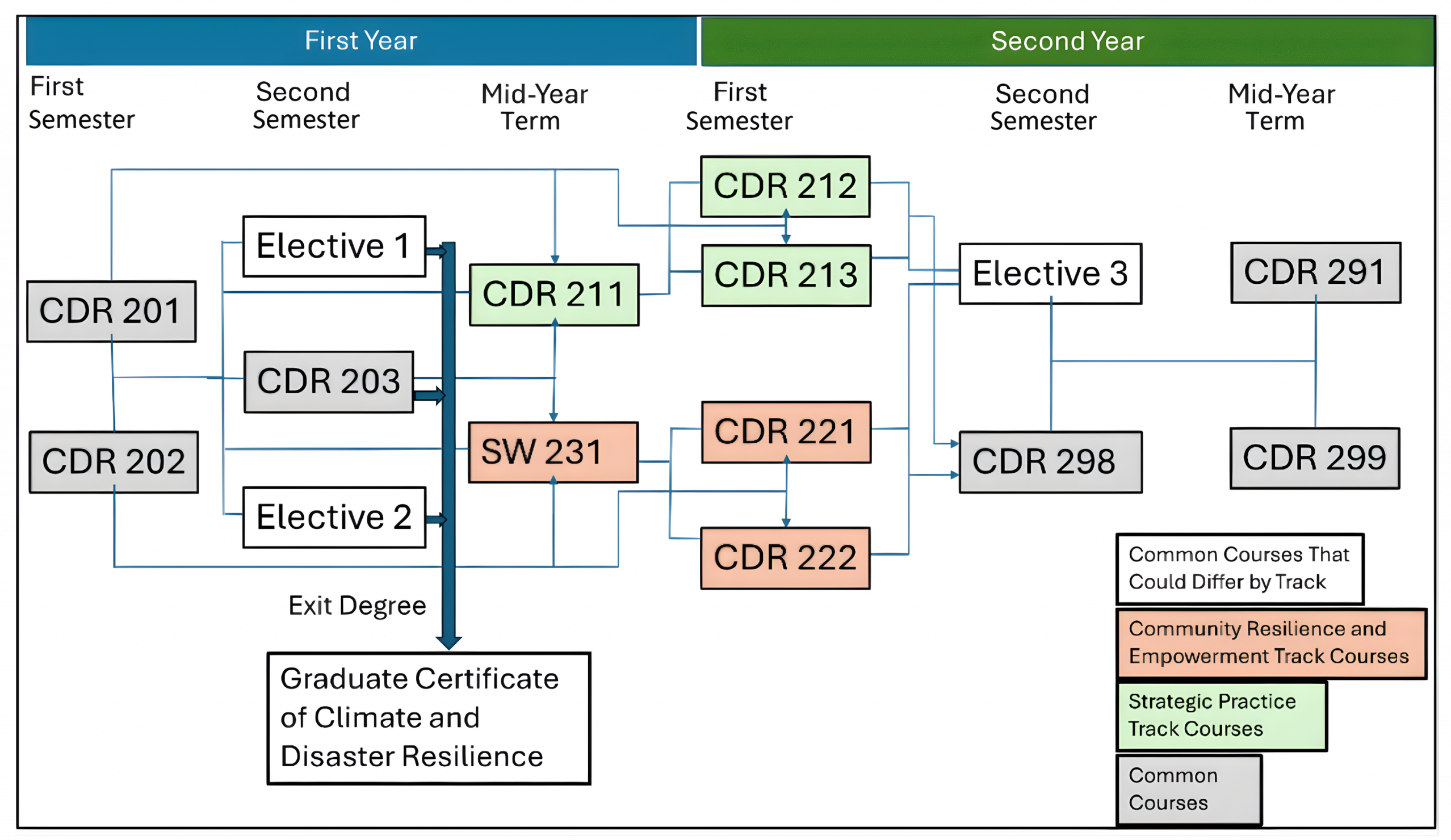
The MCDR program consists of the following courses:
| Course Code | Course Title | Course Description | No. of Units |
|---|---|---|---|
| CDR 201 | Fundamentals of Resilience | Fundamental concepts, frameworks and policies, and strategies for climate and disaster resilience. [Prerequisite: COI] |
3 |
| CDR 202 | Systems Thinking and Complexity Science for Climate and Disaster Resilience | Theories, principles, approaches, and tools of systems thinking applied in climate and disaster resilience. [Prerequisite: COI] |
3 |
| CDR 203 | Resilience and Risk Communication | Theories, practical approaches, emerging platforms and trends, and research areas in resilience communication. [Prerequisite: COI] |
3 |
| CDR 291 | Special Topics in Climate and Disaster Resilience | Emerging and specialized practices, trends and research studies in climate and disaster resilience. [Prerequisite: COI] |
3 |
| CDR 298 | Field Study in Climate and Disaster Resilience | Supervised application of climate and disaster resilience knowledge and skills in an actual practice setting. [Prerequisite: CDR 211, CDR 212 and CDR 213 or SW 231, CDR 221, and CDR 222] |
3 |
| CDR 299 | Graduate Seminar | Student-led discussion on recent research works in the field of climate and disaster resilience or outputs of field studies. [Prerequisite: COI] |
1 |
| CDR 211 | Contingency Planning and Response to Climate Change and Disasters | Principles and practical applications of DRR and CCA for effective response and contingency planning in the context of climate change and disasters. [Prerequisite: CDR 201, CDR 202, CDR 203] |
3 |
| CDR 212 | Approaches to Climate and Disaster Resilience Planning and Decision-Making | Principles, models, and frameworks in Disaster Risk Reduction and Management (DRRM) and Climate Change Adaptation and Mitigation (CCAM)-related plans, implementation, and studies. [Prerequisite: CDR 201, CDR 202, CDR 203] |
3 |
| CDR 213 | Disaster and Climate Risk Management in the Public Sector | Conceptual and practical applications of DRR-CCAM in building resilience and sustainability in the public sector. [Prerequisite: CDR 201, CDR 202, CDR 203] |
3 |
| CDR 221 | Community-based Climate and Disaster Resilience Practice | Principles and practice of community-based approaches to DRRM and CCAM. [Prerequisite: CDR 201, CDR 202, CDR 203] |
3 |
| CDR 222 | Approaches to DRRM and CCAM Education | Educational approaches to Disaster Risk Reduction and Management (DRRM) and Climate Change Adaptation and Mitigation (CCAM). [Prerequisite: CDR 201, CDR 202, CDR 203] |
3 |
| SW 231 | Strategies in Community Mobilization | Strategies and tactics in the effective mobilization of communities for social action. [Prerequisite: COI] |
3 |
Students can also enroll in 9 units from any of the elective courses:
| Course Code | Course Title | Course Description | No. of Units |
|---|---|---|---|
| CDR 230 | Field Practice in CBDRRM for Humanitarian-Development-Peace Nexus | Framework, models, and approaches in CBRRM for integrating disaster risk reduction, climate change adaptation, and sustainable development. [Prerequisite: COI] |
3 |
| CDR 231 | Community-based Vulnerability and Capacity Assessment | Theory, principles, approaches, and tools of community-based vulnerability and capacity assessment and planning. [Prerequisite: COI] |
3 |
| CDR 232 | Institutional Actions for Disaster Response | Institutional perspectives, processes, and actions for disasters due to natural and human-induced hazards. [Prerequisite: COI] |
3 |
| CDR 240 | DRR and CCAM Policy Analysis and Advocacy | Theories, legal contexts, policy analysis process, and advocacy strategies for DRR-CCAM. [Prerequisite: CDR 213] |
3 |
| CDR 241 | Disaster Risk and Climate Financing | Conceptual and theoretical perspectives and policy frameworks on disaster and climate financing. [Prerequisite: COI] |
3 |
| CDR 242 | Issues in Disaster Governance and Leadership | Concepts and key issues in disaster governance and leadership at global, regional, national and local scales. [Prerequisite: CDR 213] |
3 |
| CDR 250 | Hazards and Exposure Assessment | Natural hazards, exposure, and assessment tools in the Philippine setting. [Prerequisite: COI] |
3 |
| CDR 251 | Operational and Applied Meteorology for DRRM Practitioners | Application of meteorological principles to DRRM. [Prerequisite: COI] |
3 |
| CDR 252 | Water, Sanitation, and Hygiene for Resilience | Theory and practice of sustainable WASH principles in community development strategies. [Prerequisite: COI] |
3 |
| CDR 260 | Geodiversity and Geoheritage Towards Sustainability and Resilience | Introduction to geodiversity and geoheritage in building sustainable and resilient communities. [Prerequisite: COI] |
3 |
| CDR 261 | Ecosystems-based Approaches to Climate and Disaster Resilience | Ecosystem-based approaches and strategies for DRR and climate change adaptation and mitigation. [Prerequisite: COI] |
3 |
| CDR 270 | Ang Dalumat ng Disaster sa Pananaw at Kamalayang Pilipino | Teorya, konsepto at pamamaraan sa larangan ng pananaliksik tungkol sa disaster. [Prerequisite: COI] |
3 |
| CDR 271 | Historical Perspectives on Hazards and Disasters in the Philippines | Historical perspectives on environmental hazards and disasters in the Philippine setting. [Prerequisite: COI] |
3 |
| CDR 272 | Gender and Disaster Risk Reduction | Concepts of gender equity and social inclusion within disaster risk reduction. [Prerequisite: COI] |
3 |
| CDR 273 | Indigenous and Local Knowledge in DRRM and CCAM | Theories and practice of Indigenous Knowledge Systems in climate and disaster resilience. [Prerequisite: COI] |
3 |
| CDR 274 | Understanding Disaster Resilience: A Psychological Perspective | Psychological reactions to disasters and analysis of resilience and adaptive behaviors. [Prerequisite: COI] |
3 |
| CDR 275 | Disability-Inclusive Strategies for Climate and Disaster Resilience | Principles and practices of disability-inclusive disaster risk reduction. [Prerequisite: COI] |
3 |
| CDR 280 | Social and Emotional Learning in Climate and Disaster Resilience | Theories and practice of integrating social and emotional learning into climate and disaster resilience education. [Prerequisite: CDR 222] |
3 |
| CDR 281 | Instructional Design for Climate and Disaster-Resilient Instruction | Instructional design process and models applied to climate and disaster resilient instruction. [Prerequisite: CDR 222] |
3 |
| CDR 282 | Inclusive and Equitable Education | Theories and practice of equitable and inclusive education for climate and disaster resilience. [Prerequisite: CDR 222] |
3 |
Students are expected to take the courses in the following sequence:
| Year | First Semester | Number of Units | Second Semester | Number of Units | Midyear Term | Number of Units |
|---|---|---|---|---|---|---|
| 1 | CDR 201 | 3 | ELECTIVE 1 | 3 | CDR 211 | 3 |
| CDR 202 | 3 | CDR 203 | 3 | SW 231 | 3 | |
| ELECTIVE 2 | 3 | |||||
| 2 | CDR 212 | 3 | ELECTIVE 3 | 3 | CDR 291 | 3 |
| CDR 213 | 3 | CDR 298 | 3 | CDR 299 | 3 | |
| CDR 221 | 3 | |||||
| CDR 222 | 3 |
Program Policies
Comprehensive Examination
As part of the graduation requirements of the Program, students are required to take and pass a Comprehensive Examination.
The policies governing the examination—including eligibility requirements, coverage, schedule, format, and passing score, shall be determined by the Program. Students must meet the qualifications set by the Program before they are allowed to take the examination.
The scope and structure of the examination will reflect the core and major components of the curriculum, as defined by the Program at the time it is offered. The schedule for taking the examination will also be announced accordingly.
To ensure relevance and responsiveness to current academic and professional standards, the Program reserves the right to review and update the Comprehensive Examination policies as needed. Nonetheless, successful completion of the examination remains a mandatory requirement for graduation.
Program Exit Policy
Students who have completed 15 units of coursework, consisting of the first 3 core courses and 2 elective courses, have the option to exit the program and receive a Graduate Certificate in Climate and Disaster Resilience (GCCDR) degree.
A student who exited with the Graduate Certificate program and plans to apply for admission to the Master’s program will be considered a new applicant and must fulfill all admission requirements. The three core courses from the graduate certificate will be credited to the master’s program, provided that they were completed within five (5) years prior to admission. Otherwise, the student must take and pass a validation exam for these courses to be credited toward the master’s program.
Graduation
A student can only graduate from the program if s/he has complied the following requirements:
- completion of all course requirements
- passing a comprehensive examination
- completion and successful defense of a field study project
For those who exited with the Graduate Certificate program, they must have taken the first three core courses and two electives and completed all course and program requirements.
For admission related details, please visit UPOU website.