
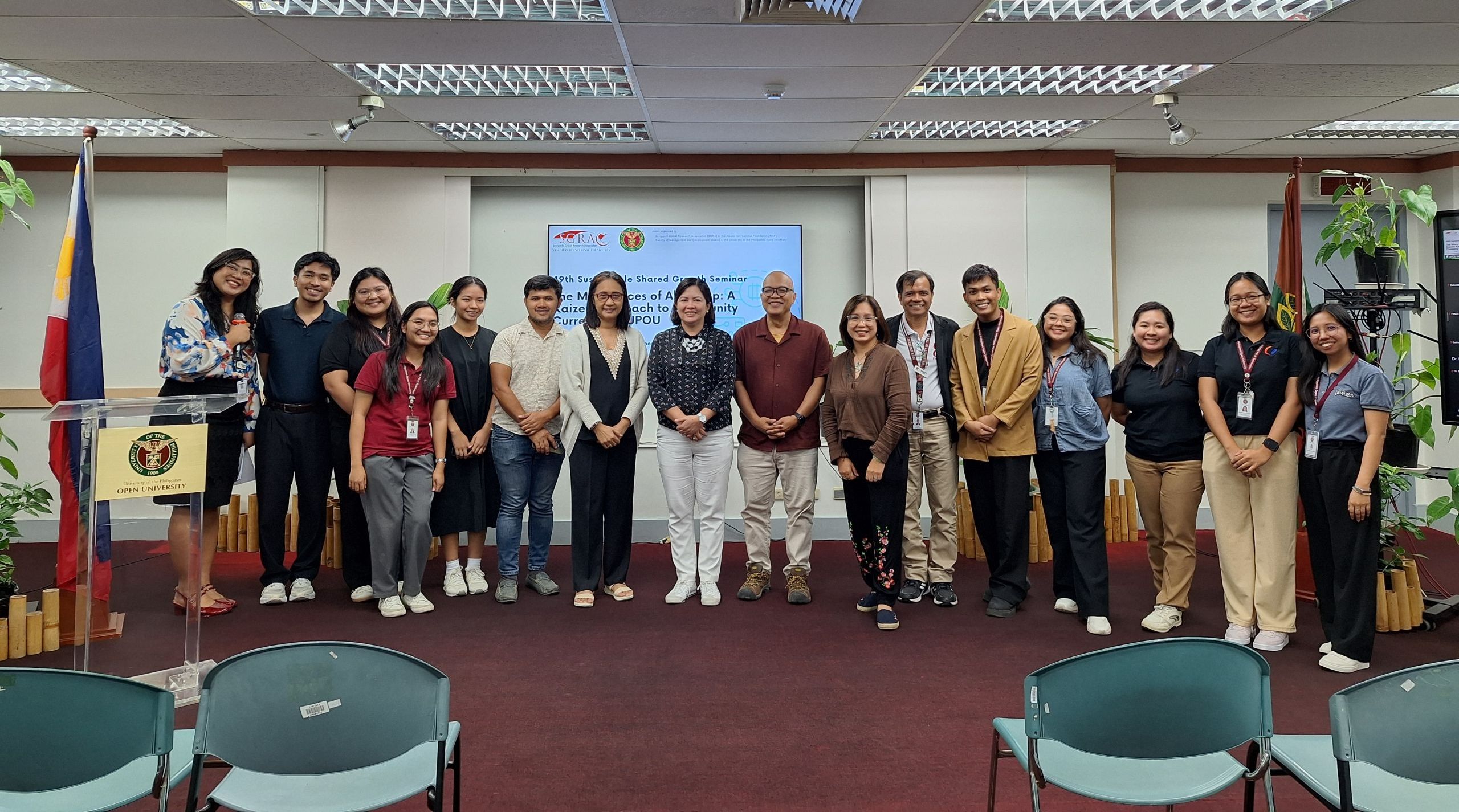
The Faculty of Management and Development Studies (FMDS) of the University of the Philippines Open University (UPOU), in partnership with the Sekiguchi Global Research Association (SGRA) of the Atsumi International Foundation (AISF), held the 49th Sustainable Shared Growth Seminar on The Many Faces of Alitaptap: A Kaizen Approach to Community Currency at UPOU last 20 February 2026 at the UPOU Audiovisual Room and via Zoom.
The seminar aimed to further strengthen the Ali community currency initiative in UPOU through kaizen, or continuous improvement, while also preparing for a panel session at the Asia Future Conference 8, which will take place in August 2026 in Sendai, Japan. The presenters discussed the initial drafts of the five papers exploring the different dimensions of Ali, fondly called “Ali” (pronounced as Eli), and examined how community currency can serve as a tool for learning, community building, enterprise development, and volunteer engagement. This is the third Sustainable Shared Growth Seminar focusing on the community currency initiative of UPOU.
Ms. Junko Imanishi, Chief Representative of the Sekiguchi Global Research Association (SGRA) and Executive Director of the Atsumi International Foundation (AISF), welcomed the participants through her opening remarks. She emphasized that the KKK seminars advance research and advocacy on mechanisms that promote sustainable shared growth, anchored on efficiency, equity, and eco-friendliness, highlighting community currency, particularly Alitaptap, as one such mechanism.
Opening the series of presentations, Prof. Joane V. Serrano, UPOU Chancellor and one of the lead proponents of Ali, discussed the initiative from an Open and Distance eLearning (ODeL) perspective. Drawing on project documentation, reflective narratives, and stakeholder feedback, her study illustrates how learners and faculty members use Ali as a platform for experiential and collaborative learning. Rather than viewing it solely as an alternative medium of exchange, the research frames Ali as a shared learning space where knowledge, trust, and resilience are co-created within a distributed academic community. Prof. Serrano also stressed on the continuous research into how the Ali CC can be used to further engage UPOU students.
Building on this educational perspective, Dr. Ferdinand Maquito examined the gamification of Ali during the Japanese Speakers’ Forum of the Philippines 2025, organized in partnership with Japan Foundation Manila and the Kamenori Foundation. Through team-based activities and focus group discussions, his study explored how “coopetition”, a blend of cooperation and competition, can enhance engagement in community currency systems. The research also reflected on cultural nuances that shape how such systems are conceptualized and implemented in different contexts.
Shifting to a social development lens, Assoc. Prof. Finaflor F. Taylan, Dean of FMDS and Program Chair of the Diploma in and Master of Social Work (D/MSW), emphasized principles of human rights, inherent dignity, and participatory community organizing in examining Ali. The study proposed the formation of a grassroots community council that could help administer Ali transactions alongside exchanges conducted in Philippine pesos. By encouraging decentralized governance and shared ownership, the initiative seeks to reduce social distance and foster greater inclusivity within the UPOU community.
The discussion then moved to the experiences of micro-enterprises participating in OUgnayan Wednesdays, as presented by Asst. Prof. Tricia Ascan, Program Chair of the Associate of Arts in Digital Entrepreneurship (AADE) and Mr. Emilio Climaco, Course Coordinator. Their study highlighted how Ali creates opportunities for circular economic exchange and local empowerment while also revealing practical challenges faced by merchants, including limited awareness, technological constraints, and uncertainty about customer adoption. By identifying actionable strategies to address these barriers, the researchers envision OUgnayan Wednesdays evolving beyond a marketplace into a dynamic learning hub for entrepreneurs exploring alternative economic models.
Adding to the perspectives, Mr. Reinald Dayson and Ms. Naomi Jean Unlayao, Project Staff of the Office of the Ugnayan ng Pahinungod presented a qualitative analysis of how OUgnayan merchants understand and position Ali community currency. Their findings describe Ali as a civic-economic hybrid that merges community-oriented values with everyday business realities. Among the six emergent themes discussed was the concept of “conditional volunteerism,” highlighting that while merchants recognize the currency’s potential to strengthen solidarity and broaden access, their participation remains shaped by practical business priorities and the need for clear structural safeguards.
Following the presentations, an open forum was held, allowing participants to share reflections, raise questions, and offer constructive recommendations in the spirit of continuous improvement. The panel members shared how they also see Ali CC progressing with the results of the kaizen.
To formally close the program, Dean Taylan expressed sincere appreciation to the speakers and participants for their active engagement and meaningful contributions. She emphasized that the seminar provided a valuable preview of the five papers to be presented at the Asia Future Conference 8 and underscored the importance of sustained interdisciplinary collaboration. She concluded by encouraging continued exploration of Ali as both a theoretical framework and a practical tool for fostering community building, shared learning, and participatory governance.
The seminar supports the UN Sustainable Development Goals (SDGs), particularly Quality Education (SDG 4), Sustainable Cities and Communities (SDG 11), and Partnerships for the Goals (SDG 17), reaffirming UPOU’s commitment to advancing community-driven and sustainable development initiatives.
Written by: Vanessa T. Autor • Edited by: Noreen Dianne S. Alazada and Larry N. Cruz
Sustainable Development Goals


FMDS Socials